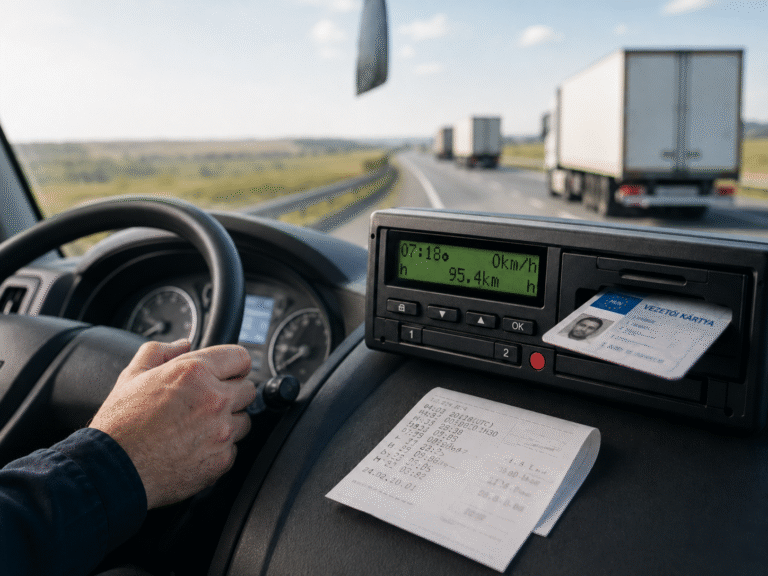
The European Union’s Mobility Package I has significantly changed working conditions, enforcement procedures and competition rules in international road transport.
The aim of the legislation is to improve working conditions for professional drivers, reduce unfair competition and make roadside enforcement more consistent across the European Union.
The Mobility Package is not a single piece of legislation. It is a collective term covering several EU regulations and directives. Its most important elements include:
- Regulation (EU) 2020/1054, which amended Regulation (EC) No 561/2006 on driving and rest times and Regulation (EU) No 165/2014 on tachographs;
- Regulation (EU) 2020/1055, which regulates access to the occupation of road transport operator and access to the international road haulage market;
- Directive (EU) 2020/1057, which establishes special rules for the posting of drivers in the road transport sector.
View Regulation (EU) 2020/1054 on EUR-Lex
Organising the Driver’s Return Home
Transport companies must organise drivers’ work so that they are able to return, within each period of four consecutive weeks, to one of the following locations:
- the company’s operational centre where the driver is normally based;
- or the driver’s place of residence.
The purpose of the return is to allow the driver to take at least one regular weekly rest period of at least 45 hours, or a longer rest period that includes compensation for previously reduced weekly rest periods.
If a driver engaged in international road haulage has taken two consecutive reduced weekly rest periods, the company must organise the driver’s return before the beginning of the next regular weekly rest period combined with the required compensation.
The company must also be able to provide documentation proving that it properly organised and enabled the driver’s return.
Vehicles No Longer Have to Return Every Eight Weeks
It is important to distinguish between the return of the driver and the return of the vehicle.
Under the previous rule, a heavy goods vehicle used in international transport had to return to the transport company’s operational centre at least once every eight weeks. However, the Court of Justice of the European Union annulled this obligation in October 2024.
This means that the mandatory return of the vehicle every eight weeks is no longer in force. The obligation to organise the regular return of the driver, however, remains applicable.
View the related press release of the Court of Justice of the European Union
The 45-Hour Weekly Rest Period Cannot Be Taken in the Cab
A regular weekly rest period of at least 45 hours cannot be taken inside the vehicle.
The same applies to any rest period longer than 45 hours that includes compensation for a previously reduced weekly rest period.
The rest period must be taken in suitable accommodation with adequate sleeping and sanitary facilities. If the driver does not take the rest period at home, the employer must cover the cost of the accommodation.
A reduced weekly rest period of at least 24 hours may still be taken in a stationary vehicle, provided that the vehicle has suitable sleeping facilities.
Two Consecutive Reduced Weekly Rest Periods
In international road haulage, drivers may take two consecutive reduced weekly rest periods under certain conditions.
The main conditions are:
- both reduced weekly rest periods must be at least 24 hours long;
- the driver must begin both rest periods outside the country where the employer is established and outside the driver’s country of residence;
- the driver must take at least four weekly rest periods within four consecutive weeks;
- at least two of those weekly rest periods must be regular weekly rest periods;
- the full compensation for both reductions must be taken immediately before the next regular weekly rest period.
This option provides greater flexibility when organising longer international journeys, but it may also result in a significantly longer combined rest period when the driver returns home.
Exceptional Extension of Driving Time to Return Home
Under exceptional and unforeseen circumstances, a driver may exceed the daily or weekly driving limit in certain cases.
- The driving time may be exceeded by up to one hour if the driver continues the journey in order to reach home or the company’s operational centre for a weekly rest period.
- The driving time may be exceeded by up to two hours if the driver is returning for a regular weekly rest period and has taken an uninterrupted break of at least 30 minutes before the additional driving time.
This possibility must not be used as a planned transport-management method. It may only be applied in exceptional circumstances that could not reasonably have been foreseen.
The extension must not endanger road safety. The driver must manually record the reason for the extension on a tachograph printout or by another appropriate method.
The additional driving time must be compensated by an equivalent period of rest no later than the end of the third week following the week in question.
Posting of Drivers: When Is a Driver Considered a Posted Worker?
The posting rules determine when the mandatory employment conditions and remuneration rules of another Member State must be applied during transport operations carried out in that country.
Operations That Are Generally Not Considered Posting
- bilateral transport operations, for example when a Hungarian company transports goods from Hungary to Germany and then returns;
- pure transit, where the vehicle passes through a country without loading or unloading;
- certain limited additional loading or unloading operations connected to a bilateral transport operation.
Operations That Are Generally Considered Posting
- cabotage operations;
- cross-trade operations, where the transport company carries out a transport operation between two countries, neither of which is the country where the company is established.
For a Hungarian transport company, for example, a transport operation between Germany and France may qualify as cross-trade.
During cabotage and cross-trade operations, the driver may be subject to the mandatory remuneration and working conditions of the host country for the duration of the work performed there.
View Directive (EU) 2020/1057 on EUR-Lex
IMI Posting Declaration and Documents Carried by the Driver
The transport company must submit a posting declaration through the European Union’s Internal Market Information System, known as the IMI system, before the posting begins.
During a roadside inspection, the driver must be able to present the following documents either on paper or electronically:
- a copy of the IMI posting declaration;
- a document proving the transport operation, such as a CMR or e-CMR consignment note;
- the required tachograph records;
- records relating to border crossings and country entries.
Main Cabotage Rules
Cabotage refers to a domestic transport operation carried out within a country by a transport company established in another Member State.
For example, it is considered cabotage if a Hungarian transport company carries goods from Munich to Hamburg within Germany.
Following an incoming international transport operation, a maximum of three cabotage operations may generally be carried out within seven days.
After the final cabotage operation has been completed, the same vehicle may not begin another cabotage operation in the same country for four complete calendar days.
During this four-day cooling-off period, the vehicle may carry out international transport, transit or even cabotage operations in another country. However, it may not carry out another domestic transport operation in the country where the cooling-off period applies.
European Commission information on cabotage rules
Tachographs and the Roadside Inspection Period
The Mobility Package has significantly increased the importance of tachographs and accurate activity recording.
During roadside inspections, authorities may check the driver’s driving, rest and other activity records for the current day and the preceding 56 days.
It is therefore especially important to ensure:
- the correct tachograph mode is selected;
- other work is recorded accurately;
- periods of availability are recorded correctly;
- rest periods are entered properly;
- manual entries are completed correctly;
- the driver card is used in accordance with the rules.
Second-Generation Smart Tachographs
For heavy goods vehicles engaged in international transport, the transition to second-generation smart tachographs was completed by August 2025.
These newer devices can:
- automatically record border crossings;
- record the location of the vehicle more accurately;
- allow certain information to be screened remotely before a roadside inspection;
- support the enforcement of cabotage and posting rules.
New Obligations for Light Commercial Vehicles Over 2.5 Tonnes
From 1 July 2026, the rules also apply to light commercial vehicles and vehicle combinations with a maximum permissible mass exceeding 2.5 tonnes when they are used for international road haulage or cabotage.
These vehicles must also be equipped with a second-generation smart tachograph, and their drivers must comply with the applicable driving time, break and rest period rules.
European Commission information on smart tachographs
What Does the Mobility Package Mean for Transport Companies?
For transport companies, the Mobility Package primarily introduces stricter organisational and administrative obligations.
Transport companies must:
- plan transport operations so that drivers can return home and take their weekly rest periods in accordance with the rules;
- provide and pay for suitable accommodation when required;
- determine whether an operation qualifies as bilateral transport, cross-trade or cabotage;
- manage IMI posting declarations;
- take the remuneration and working conditions of the host country into account;
- comply with the seven-day and four-day cabotage restrictions;
- ensure that the correct tachograph is installed and used properly;
- regularly download and review tachograph and driver-card data;
- retain documents proving driver return arrangements, working time, remuneration and transport operations.
A breach of the rules may result not only in an on-the-spot fine for the driver. The transport company may also be held responsible.
Repeated or serious infringements may negatively affect the company’s risk rating, jeopardise compliance with the good-repute requirement and, in extreme cases, put the company’s operating licence at risk.
What Should Drivers Check Before Departure?
Before beginning an international transport operation, drivers should check that:
- the tachograph is operating correctly;
- the driver card is valid and functioning;
- all necessary manual entries and previous activities have been recorded;
- the CMR or e-CMR consignment note is available;
- the IMI posting declaration is available when posting rules apply;
- it is clear whether the operation is bilateral transport, cross-trade or cabotage;
- the weekly rest period and return home have been planned in advance;
- suitable accommodation has been arranged for the regular weekly rest period;
- the dates and times of previous cabotage operations have been checked;
- the applicable four-day cooling-off period has expired.
Summary
The Mobility Package has not completely replaced the existing system of driving and rest times, but it has made the rules on weekly rest, the return of drivers, posting, cabotage and tachograph enforcement considerably stricter.
The most important changes for drivers include:
- more accurate recording of rest periods and other activities;
- the 56-day roadside inspection period;
- the requirement to take regular weekly rest outside the vehicle;
- the obligation to present posting and transport documents;
- the correct recording of border crossings and country entries.
For transport companies, the greatest challenges are proper route and working-time planning, compliance with foreign remuneration rules, arranging accommodation and managing increasingly detailed administrative requirements.