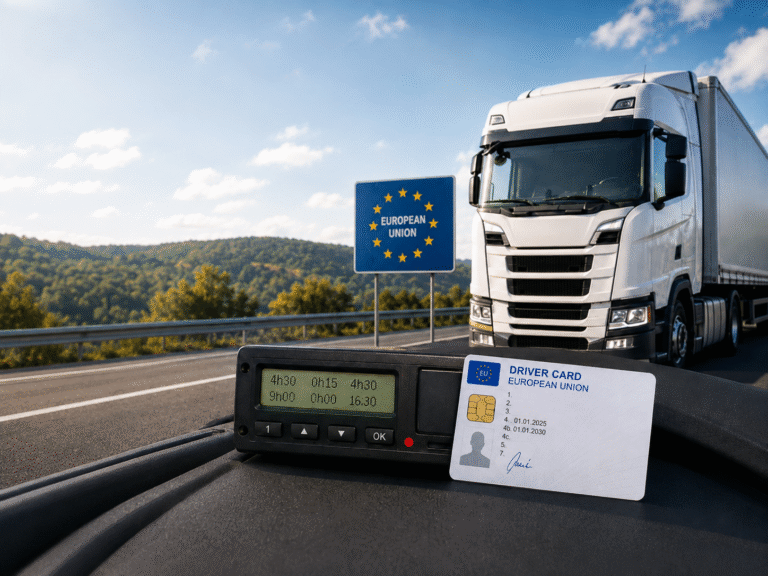
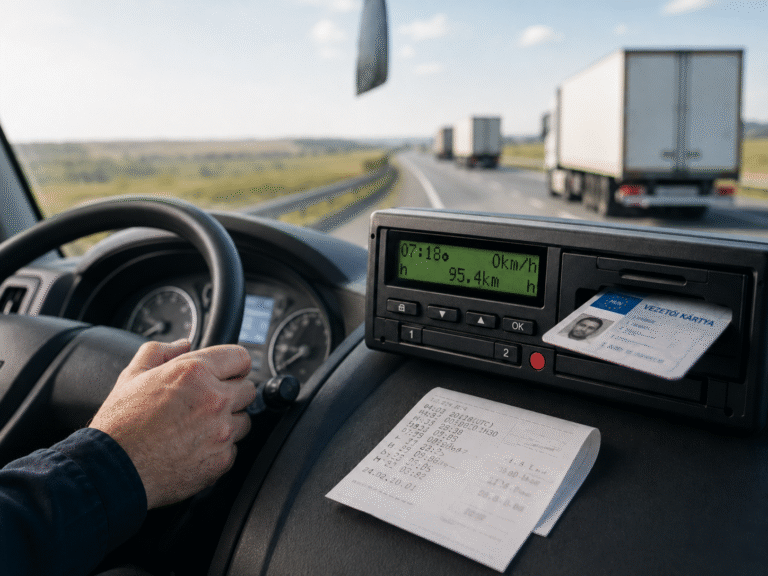
Regulation (EC) No 1072/2009 is one of the fundamental laws governing international road haulage within the European Union. It defines which authorisations a transport operator needs to carry out international freight transport, under what conditions it may perform domestic transport operations in another Member State, and which documents must be presented during an inspection.
The Regulation therefore does not primarily concern driving and rest times. Instead, it determines who may access the EU road haulage market, with which vehicle, under which authorisation and subject to what conditions.
Which transport operations does it apply to?
The Regulation generally applies to road haulage operations carried out for hire or reward, including:
- international freight transport between EU Member States;
- the part of a transport operation between the European Union and a third country that takes place within EU territory;
- temporary domestic transport operations carried out in another Member State, known as cabotage.
For example, cabotage occurs when a Hungarian transport operator delivers a load from Hungary to Germany, then collects another load in Berlin and delivers it to Munich. This is a German domestic transport operation performed by a company that is not established in Germany.
Community licence: international transport is not permitted without it
A transport operator carrying out international road haulage for hire or reward must hold a Community licence. The licence is issued by the competent authority of the Member State in which the transport undertaking is established.
The original licence must be kept by the transport company, but a certified true copy of the Community licence must be carried in every vehicle used. The driver must be able to present it during a roadside inspection.
The licence may not be transferred to another company. In the case of a vehicle combination, the certified copy of the licence is linked to the motor vehicle, usually the tractor unit.
Since 21 May 2022, the exemption applies only to vehicles and vehicle combinations with a maximum permissible laden mass not exceeding 2.5 tonnes. As a result, a Community licence may also be required for international carriage of goods for hire or reward using vans or light commercial vehicles exceeding 2.5 tonnes.
When is a driver attestation required?
If the driver is not an EU citizen and does not have long-term resident status under EU law, the transport operator will generally need to provide a driver attestation.
This document confirms that the driver is lawfully employed by the transport operator. It must be carried by the driver while driving and presented during roadside inspections.
The most important cabotage rules
Cabotage may only be carried out after a genuine and completed international transport operation. Following the complete unloading of the incoming international consignment, the same motor vehicle may perform:
a maximum of three cabotage operations within seven days.
The seven-day period begins on the day following the final unloading of the incoming international transport operation. The final permitted cabotage operation must be completed no later than the end of the seventh day.
The three cabotage operations may be carried out:
- entirely within the Member State where the international consignment was delivered;
- partly in other EU Member States.
If cabotage is carried out in a Member State other than the destination country of the incoming international operation, only one cabotage operation may be performed in that other Member State. It must be completed within three days of entering that country without cargo and within the original seven-day time limit.
Four-day cooling-off period
After completing a series of cabotage operations, the same motor vehicle may not begin another cabotage operation in the same Member State for four days.
This is known as the cooling-off period. Its purpose is to prevent foreign transport operators from effectively carrying out permanent domestic transport activities in another country.
The four-day restriction applies to the specific country and the specific motor vehicle. During this period, the vehicle may:
- transit through the country;
- perform an international transport operation to or from the country;
- carry out cabotage in another Member State, provided the applicable conditions are met.
However, the operator must wait until the four-day period has expired before beginning another cabotage operation in the same country.
Cabotage is linked to the tractor unit
In the case of a vehicle combination, the motor vehicle, usually the tractor unit, must be taken into account when applying the cabotage rules.
The cabotage operations must be carried out by the tractor unit that participated in the preceding incoming international transport operation. The trailer or semi-trailer may, however, be changed.
The three-operation limit, the seven-day period and the four-day cooling-off period must therefore be recorded and monitored separately for each tractor unit.
Which documents must be presented?
During a roadside inspection, the operator must be able to provide clear evidence of:
- the international transport operation that preceded the cabotage operations;
- all cabotage operations subsequently carried out;
- where necessary, transport operations performed in the country during the preceding four days.
The transport documents must contain information including:
- the details of the consignor, carrier and consignee;
- the place and date of loading and unloading;
- the description, packaging, quantity or weight of the goods;
- the registration number of the tractor unit and, where applicable, the trailer;
- the delivery date and confirmation from the consignee.
This information is usually contained in a CMR consignment note, another transport document or an electronic consignment note. A separate cabotage certificate is generally not required, but the relevant documents must be made available during the inspection.
Electronic documents and e-CMR consignment notes may also be accepted. During the inspection, the driver may contact the dispatcher, transport manager or company headquarters so that the required evidence can be sent before the inspection is completed.
The rules of the host country must also be followed
During cabotage operations, it is not enough to comply only with the EU limits on the number and timing of operations. The rules of the host Member State also apply, including rules concerning:
- the conditions governing the transport contract;
- permitted vehicle weights and dimensions;
- the transport of dangerous goods, perishable food and live animals;
- driving and rest times;
- tax and VAT rules affecting transport services.
Before departure, the dispatcher and the driver must therefore check not only whether another cabotage operation is still permitted, but also which local transport and traffic rules apply in the country concerned.
How does this affect transport operators?
Regulation (EC) No 1072/2009 directly affects transport planning and vehicle allocation. For each vehicle, the company must keep track of:
- which international transport operation established the right to carry out cabotage;
- when the final international unloading took place;
- how many cabotage operations have already been performed;
- when the seven-day period expires;
- in which country and when the four-day cooling-off period began;
- whether all documents required for an inspection are available.
These rules limit how often a foreign vehicle may operate within the domestic transport market of another Member State. They affect route planning, the selection of return loads, the number of empty kilometres, dispatch operations and the calculation of freight rates.
What can happen in the event of a violation?
The exact amount of any fine is determined by the national legislation of each Member State. However, the consequences may extend beyond an on-the-spot financial penalty.
Serious or repeated infringements may result in:
- the temporary or permanent withdrawal of certified copies of the Community licence;
- the withdrawal of the Community licence itself;
- the suspension or withdrawal of a driver attestation;
- an assessment of the transport operator’s good repute.
The authority of the host Member State may also notify the competent authority of the country in which the transport operator is established.
In summary: what should the driver check?
Before an international or cabotage operation, the driver should check whether:
- a certified true copy of the Community licence is carried in the vehicle;
- a driver attestation is available where required;
- the documents relating to the preceding international transport operation and all cabotage operations are accessible;
- the operation remains within the limit of three operations and the seven-day period;
- the four-day cooling-off period applicable to the country has expired;
- the registration numbers and the loading and unloading details are correctly recorded in the transport documents.
The most important practical rule: cabotage should only be undertaken after a fully documented and completed international transport operation, while continuously monitoring the applicable limits on the number and timing of operations.