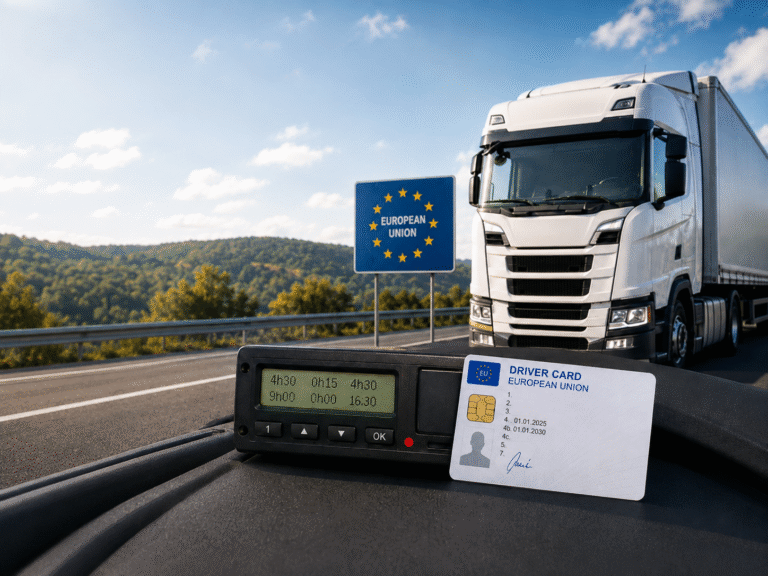
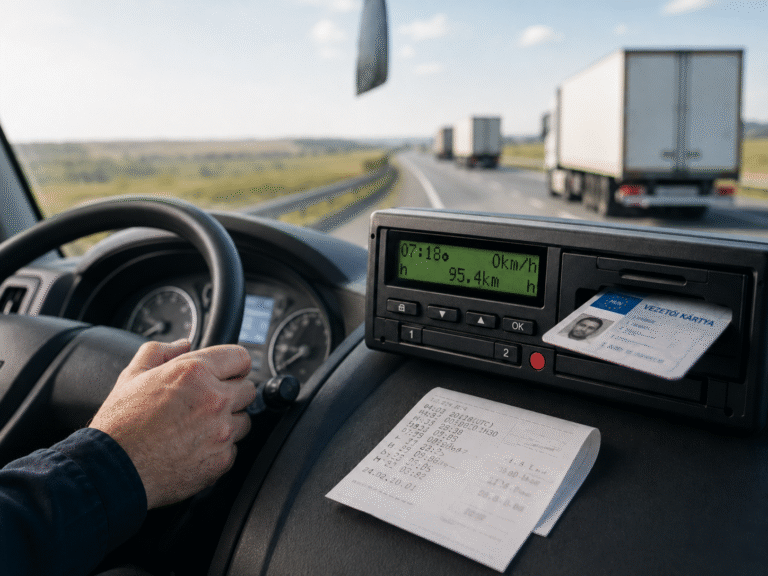
From 1 July 2026, EU rules on tachographs, driving times and rest periods also apply to certain light commercial vehicles exceeding 2.5 tonnes. However, this does not mean that tachograph use has become mandatory for every van above this weight. An official response from the European Commission has clarified several important practical questions.
On 22 July 2026, the European Commission’s Directorate-General for Mobility and Transport responded to questions concerning tachograph obligations for light commercial vehicles.
The document specifically addresses domestic transport, occasional international journeys, own-account transport, driver cards and the use of the “OUT OF SCOPE” mode.
What changed on 1 July 2026?
From 1 July 2026, EU rules on driving times and rest periods also apply to the carriage of goods where:
- the operation is carried out in international transport or as a cabotage operation;
- and the maximum permissible mass of the vehicle or vehicle combination – including any trailer or semi-trailer – exceeds 2.5 tonnes.
This means that many van operators that previously did not use tachographs are now covered by the rules.
For affected transport operations, companies must consider more than simply installing the device. Drivers must use a driver card and comply with the rules on driving periods, breaks and rest periods. The undertaking must also arrange for the downloading, storage and inspection of tachograph data.
Exclusively domestic transport is not automatically covered by the new rule
One of the most important conclusions in the Commission’s letter is that the new EU obligation for light commercial vehicles exceeding 2.5 tonnes specifically applies to international goods transport and cabotage operations.
If a vehicle operated by a Hungarian company is used exclusively for domestic transport within Hungary, it does not automatically become subject to the tachograph requirement under the new EU rule.
According to the European Commission’s position, a driver who exclusively and permanently performs domestic work outside the scope of the EU rules is not required under EU law to obtain a driver card.
However, this does not prevent a Member State from introducing its own national requirements for domestic transport. Operators must therefore also check whether the national legislation of the relevant country imposes any additional obligations.
Even a single occasional international journey may be enough
A driver is not automatically exempt simply because they only drive abroad occasionally or because driving is not identified as their primary duty in their employment contract.
If an employee performs an international transport operation that falls within the scope of the EU rules, even only occasionally, then during that journey the employee must:
- hold a valid driver card;
- use the card correctly;
- comply with the applicable driving-time and rest-period rules.
This is particularly important for businesses that normally operate domestically but occasionally send vans to Austria, Slovakia, Romania or another EU Member State.
Saying that “we only travel abroad a few times a year” does not in itself provide an exemption.
When may own-account transport be exempt?
The legislation may provide an exemption for certain own-account transport operations where the maximum permissible mass of the vehicle or vehicle combination exceeds 2.5 tonnes but does not exceed 3.5 tonnes.
Several conditions must be met at the same time for the exemption to apply. In particular:
- the transport must not be performed for hire or reward;
- the goods must belong to the undertaking or must have been purchased, sold, produced, processed or repaired by the undertaking;
- the transport must serve the undertaking’s own requirements;
- the vehicle must be driven by an employee of the undertaking or by a person made available to it under a contractual arrangement;
- the transport activity must only be ancillary to the undertaking’s overall activities;
- driving must not be the main activity of the person driving the vehicle.
An example could be a carpenter transporting furniture manufactured by their own business to a customer abroad, or a technician carrying their own tools and spare parts needed to perform a job.
The situation is different where a company transports goods belonging to another party in return for payment. This would generally be considered a transport service, and the own-account exemption would not apply.
What does it mean for driving not to be the employee’s main activity?
The Commission’s letter refers to another EU directive under which driving is generally not considered the person’s principal activity where it accounts for less than 30% of their rolling monthly working time.
However, the 30% threshold should not automatically be treated as a universal tachograph-exemption limit. This definition originally appears in legislation concerning the qualification and training of professional drivers.
During a roadside inspection, the authorities may also examine the actual circumstances, including:
- the duties stated in the employment contract;
- the tasks regularly performed by the employee;
- the amount of time spent driving;
- the principal activity of the undertaking;
- whether transport is provided as a separate service or is merely an ancillary task.
A business relying on the exemption should therefore be able to demonstrate that the relevant conditions are satisfied by means of appropriate working-time records and transport documents.
The presence of a tachograph does not mean it must be used on every journey
According to the European Commission, the mere presence of a tachograph in the vehicle does not mean that the driver card must be used for every vehicle movement.
If a tachograph-equipped vehicle is being used for a domestic or other activity that falls outside the scope of the EU rules on driving times and rest periods, the installation of the device does not in itself make that journey subject to the tachograph requirements.
Accurate documentation is particularly important for vehicles used for mixed operations. If the same van performs a domestic journey on one day and an international transport operation on the next, the undertaking must be able to distinguish clearly between the different activities.
When may “OUT OF SCOPE” mode be used?
The “OUT” or “OUT OF SCOPE” function indicates that the particular use of the vehicle falls outside the scope of the EU rules on driving times and rest periods.
According to the European Commission, there is no specific provision requiring the OUT mode to be selected for every out-of-scope journey.
Nevertheless, the Commission expressly recommends that the driver:
- insert their driver card;
- select the “OUT OF SCOPE” mode.
This may be simpler and less prone to error than entering the activities manually at a later stage. During a subsequent roadside inspection, it may also make it clearer to the authorities why the driver was not performing work covered by the Regulation during that period.
However, OUT mode must only be used for activities that genuinely fall outside the scope of the rules. For example, the Hungarian section of an international journey must not be recorded in OUT mode merely because the vehicle has not yet crossed the national border.
Practical examples for transport operators
1. A 3.2-tonne van operating exclusively within Hungary
The vehicle only travels between loading and unloading locations situated in Hungary.
It does not automatically become subject to the tachograph requirement under the new EU rule. However, the applicable Hungarian national rules must still be taken into account.
2. The same van transports goods from Budapest to Vienna
This is an international goods transport operation. If the maximum permissible mass of the vehicle or the vehicle combination, including any trailer, exceeds 2.5 tonnes, the tachograph and driving-time rules generally apply.
3. A company transports its own manufactured product abroad
An exemption may be available where the operation is genuine own-account transport, no separate transport charge is applied, transport is only an ancillary activity, and driving is not the employee’s main task.
4. A driver works domestically throughout the year but travels abroad twice a year
The driver must have a driver card for the international journeys, and the tachograph rules must be applied to those operations. The occasional nature of the journeys does not in itself provide an exemption.
5. A 2.4-tonne van tows a trailer
The maximum permissible mass of the van is not the only figure that must be considered. If the combined maximum permissible mass of the van and trailer exceeds 2.5 tonnes, the vehicle combination may fall within the scope of the rules when used for international goods transport.
What should businesses do now?
Transport operators and other businesses using vans should first review their entire vehicle fleet.
For each vehicle, the following questions should be examined:
- Does the maximum permissible mass of the vehicle or vehicle combination exceed 2.5 tonnes?
- Is it used for international goods transport or cabotage operations?
- Is the transport performed for hire or reward?
- Where own-account transport is involved, are all exemption conditions satisfied?
- Is driving the employee’s main activity?
- Is the vehicle equipped with the correct tachograph, and does the driver have a valid driver card?
- Are out-of-scope journeys properly documented?
Affected undertakings must also arrange for:
- driver training;
- driver cards and company cards;
- regular downloading of tachograph data;
- retention of the data for the required period;
- proper planning of driving periods, breaks and rest periods;
- correct use of manual entries and OUT mode.
Businesses relying on the own-account exemption should provide drivers with documents that can demonstrate:
- who owns the goods being transported;
- the purpose of the transport operation;
- the principal activity of the undertaking;
- the driver’s actual job responsibilities;
- what proportion of the employee’s working time is spent driving;
- why the operation qualifies as ancillary own-account transport.
The most important conclusion
The statement that “from 1 July 2026 every van over 2.5 tonnes requires a tachograph” is not accurate.
The vehicle’s weight is not the only factor that must be examined when determining whether the rules apply. It is equally important to establish:
- whether the operation is domestic or international;
- whether cabotage is being performed;
- whether the company is transporting its own goods or goods belonging to another party;
- whether the transport is performed for payment;
- whether driving is the driver’s main activity.
The rules therefore cannot be determined simply at company or vehicle-category level. The obligations must be assessed separately for each vehicle, driver and transport operation.
The European Commission’s letter provides important guidance, but the specific circumstances of each transport operation remain decisive. In cases of uncertainty, it is advisable to obtain an opinion from a competent authority or a specialist in road transport law before carrying out the operation.
Source: The European Commission Directorate-General for Mobility and Transport’s official response of 22 July 2026 concerning tachograph obligations for light commercial vehicles.