Important clarification: the correct reference for the European Union legislation governing tachographs is Regulation (EU) No 165/2014, not Regulation 165/2006. It is closely connected to Regulation (EC) No 561/2006, but the two regulations govern different areas.
Regulation (EC) No 561/2006 sets out the rules on driving times, mandatory breaks, and daily and weekly rest periods. Regulation (EU) No 165/2014, on the other hand, determines how these periods and the driver’s other activities must be recorded, stored, and made available for inspection using a tachograph.
What Is a Tachograph Used For?
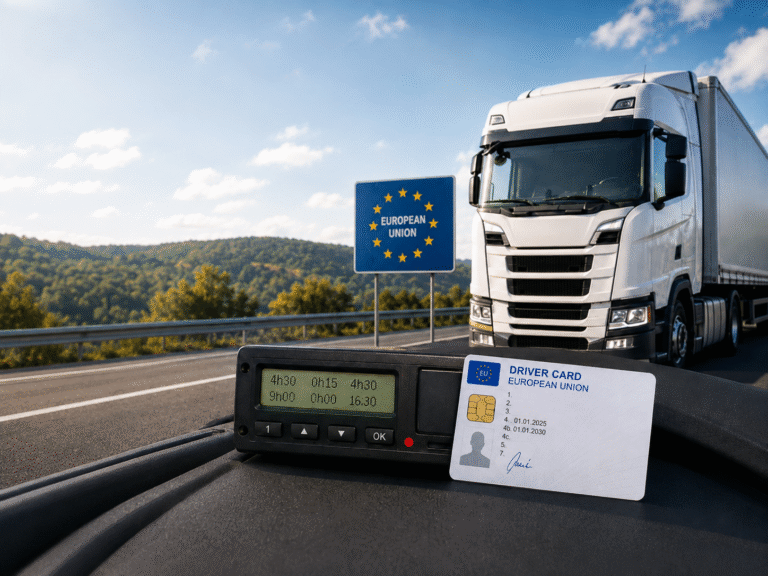
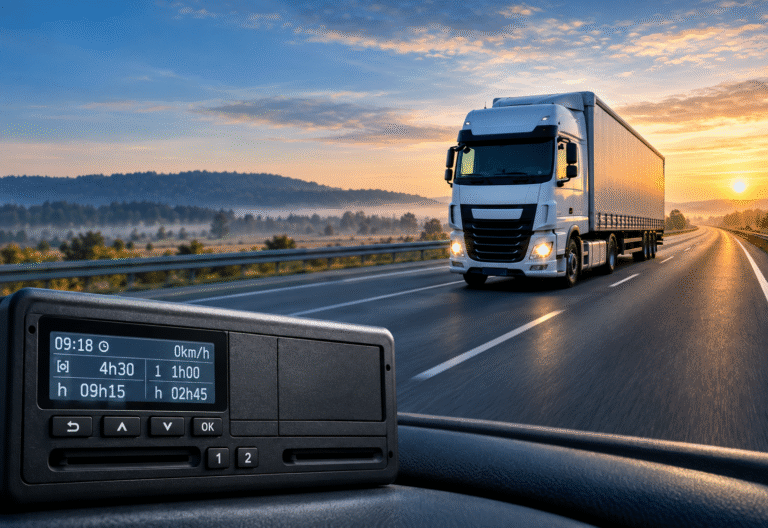
A tachograph is a monitoring device that records information about the vehicle and the activities of the driver.
Among other things, the device records:
- driving time;
- distance travelled;
- vehicle speed;
- breaks and rest periods;
- time spent on other work;
- periods of availability;
- in certain cases, the vehicle’s position and border crossings.
The purpose of the system is to make compliance with driving and rest-time rules verifiable, reduce driver fatigue, improve road safety, and create fairer competitive conditions between transport operators.
Which Vehicles Are Covered?
As a general rule, a tachograph must be used in:
- goods vehicles and vehicle combinations with a maximum permissible mass exceeding 3.5 tonnes;
- buses and coaches designed to carry more than nine people, including the driver.
From 1 July 2026, the rules also apply to light commercial vehicles exceeding 2.5 tonnes when they are used for international goods transport or cabotage operations. These vehicles must be equipped with a second-generation smart tachograph.
Certain specialised vehicles, transport operations, and activities may be exempt from the tachograph rules. The exemptions applicable to the particular journey must therefore always be considered.
The Driver’s Main Responsibilities
Drivers must use their driver card on every day when they drive a vehicle that is subject to the tachograph rules. The card must be inserted into the tachograph when the driver takes control of the vehicle.
When the vehicle is operated by a multi-manning crew, each driver must use the correct card slot. Using another person’s driver card is strictly prohibited.
The driver must always select the activity that reflects what they are actually doing:
- driving;
- other work, such as loading, vehicle checks, refuelling, or administrative work;
- period of availability;
- break or rest;
- where necessary, ferry or train mode.
If the driver performed work away from the vehicle, rested, was on holiday, or was on sick leave, the relevant period must be entered manually when the driver card is next inserted.
Recording Country Codes and Border Crossings
The country in which the daily working period begins and ends must be recorded in the tachograph.
When using a tachograph that does not automatically record border crossings, the driver must enter the country code of the new Member State at the first possible and safe stopping place after crossing the border.
A second-generation smart tachograph records border crossings automatically. As a result, manual country-code entry is generally not required when using these devices.
What Must Be Presented During a Roadside Inspection?
When using a digital tachograph, the driver must make the following available to the inspecting authority:
- their driver card;
- the records relating to the current day;
- manual entries and printouts relating to the previous 56 days;
- any analogue tachograph charts used during the same period, if the driver also drove a vehicle equipped with an analogue tachograph.
The 56-day inspection period has applied since 31 December 2024. Previously, inspections generally covered the current day and the preceding 28 days.
What Happens if the Driver Card Is Lost or Malfunctions?
If a driver card is lost, stolen, or defective, the driver must apply for a replacement card within seven calendar days.
Driving without a card is generally permitted for no more than 15 calendar days, provided that the driver can prove that using the card became impossible for reasons beyond their control. A longer period may only be justified where the vehicle must return to its operating base.
While driving without a card, a tachograph printout must be produced at the beginning and end of every working day. The printout must include:
- the driver’s name;
- the driving licence number or driver card number;
- any activities not shown on the printout;
- the driver’s signature.
What Does the Regulation Mean for Transport Operators?
Correct tachograph use is not solely the responsibility of the driver. Transport undertakings are also subject to several obligations.
The operator’s responsibilities include:
- providing proper training to drivers;
- regularly monitoring tachograph use;
- ensuring that the tachograph operates correctly;
- providing sufficient printer paper in the vehicle;
- regularly downloading and storing tachograph data;
- arranging periodic inspections and calibration of the equipment;
- ensuring that defective tachographs are repaired;
- organising work in a way that allows drivers to comply with driving and rest-time rules.
A transport operator must not issue instructions or establish payment or incentive systems that could encourage drivers to use the tachograph incorrectly, exceed permitted driving times, or reduce mandatory rest periods.
Data Download Requirements
Data stored on the digital tachograph and driver card must be downloaded regularly.
As a general rule:
- data must be downloaded from the driver card at least every 28 days;
- data must be downloaded from the vehicle unit at least every 90 days.
Downloads must be carried out frequently enough to prevent data loss. The transport operator must store the information in an organised manner and ensure that it is accessible during an inspection.
Tachograph Inspection and Repair
The tachograph must be inspected by an authorised workshop at least once every two years. An additional inspection may also be necessary if there is a change to:
- the vehicle registration number;
- the tyre size or effective rolling circumference;
- the vehicle motion sensor;
- an important tachograph setting;
- calibration data relating to the vehicle or device.
If the tachograph develops a fault during a journey, the transport operator must arrange for it to be repaired as soon as possible. If the vehicle cannot return to its operating base within one week, the repair must be carried out while the vehicle is away.
While the tachograph is defective, the driver must manually record any information that the device failed to record correctly.
What Has Changed With Smart Tachographs?
Second-generation smart tachographs can automatically record more information than older devices.
This may include:
- the starting and finishing points of the daily working period;
- the location of border crossings;
- loading and unloading operations;
- the vehicle’s position at specified intervals.
Smart tachographs also allow enforcement authorities to perform a preliminary remote check of certain information without stopping the vehicle. This does not mean that penalties are issued automatically, but it can help authorities identify vehicles that may require a more detailed roadside inspection.
For vehicles operating internationally, the transition to the latest tachographs has involved significant investment and organisational work for transport operators. At the same time, the new system allows more accurate enforcement of border-crossing, cabotage, and driving-time rules.
Why Is Correct Tachograph Operation Important?
Incorrect tachograph use may constitute a separate infringement even if the driver has not exceeded the permitted driving time.
Examples of possible infringements include:
- selecting the wrong activity mode;
- failing to make required manual entries;
- failing to enter a required country code;
- inserting the driver card too late or removing it too early;
- using another person’s driver card;
- failing to produce required printouts;
- downloading data late;
- tampering with the tachograph;
- deleting or falsifying recorded information.
Tampering with a tachograph and falsifying recorded data are considered serious infringements. Both the driver and the transport operator may be held responsible for violations.
How Does the Regulation Affect the Daily Operation of Transport Companies?
Regulation (EU) No 165/2014 has a direct effect on the daily organisation of transport undertakings. Among other things, it influences:
- route and transport-task planning;
- driver scheduling;
- the allocation and replacement of vehicles;
- driver-card management;
- the downloading and archiving of tachograph data;
- internal compliance procedures;
- driver training;
- vehicle servicing and tachograph calibration;
- preparation for roadside and company-premises inspections.
Accurate tachograph operation is therefore not merely an administrative task. An effective compliance system can prevent infringements, reduce the risk of fines, and make it easier for the company to demonstrate that drivers’ work has been organised correctly.
Summary
Regulation (EU) No 165/2014 does not determine how many hours a driver may drive. It governs how driving, other work, periods of availability, breaks, and rest periods must be reliably recorded, stored, and demonstrated during inspections.
For the driver, this primarily means:
- using the driver card correctly;
- selecting the correct activity mode;
- making the necessary manual entries;
- recording country codes correctly;
- presenting the required records and printouts during inspections.
For the transport operator, it creates obligations relating to:
- training;
- monitoring;
- data downloads;
- data storage;
- maintenance;
- work organisation.
Accurate management of tachograph data is in the shared interest of both the driver and the transport operator. Incorrect or incomplete records may result in substantial fines, enforcement proceedings, and damage to the transport undertaking’s good repute.