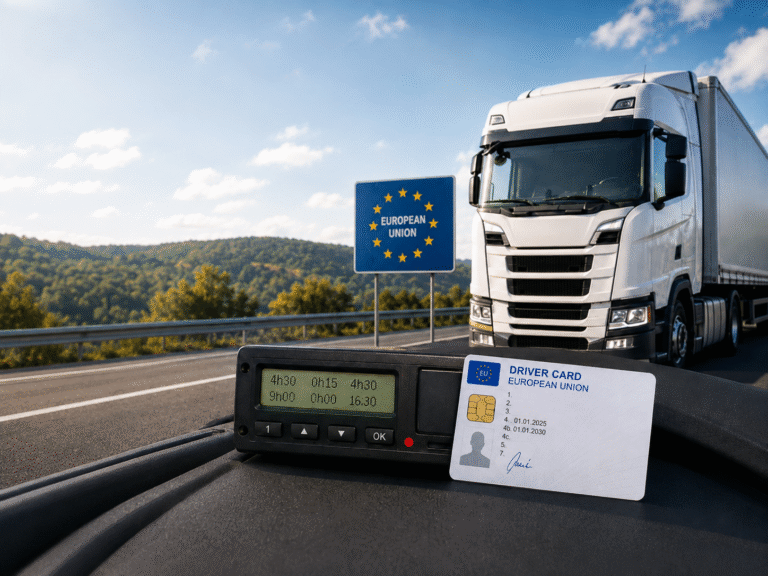
The European Union’s Mobility Package has introduced stricter controls for road transport in several stages. One of the most important changes is that from 1 July 2026, certain vehicles with a maximum permissible mass between 2.5 and 3.5 tonnes must also be equipped with a smart tachograph.
The rule primarily affects van-based transport companies carrying out international operations, many of which were previously able to operate without a tachograph.
Which vehicles are covered by the new requirement?
From 1 July 2026, a tachograph must be used in goods vehicles where:
- the maximum permissible mass of the vehicle, including any trailer or semi-trailer, exceeds 2.5 tonnes;
- the vehicle is used for international goods transport or cabotage operations in another EU Member State;
- the operation does not fall under a specific legal exemption.
It is important to note that when determining whether the 2.5-tonne threshold is exceeded, the maximum permissible mass of the trailer must also be taken into account. This means that a van weighing less than 2.5 tonnes on its own may still fall under the rules when towing a trailer.
The change particularly affects international express transport, parcel delivery, urgent freight services and other operations carried out with smaller commercial vans.
Current consolidated version of Regulation (EC) No 561/2006 on EUR-Lex
What type of tachograph must be used?
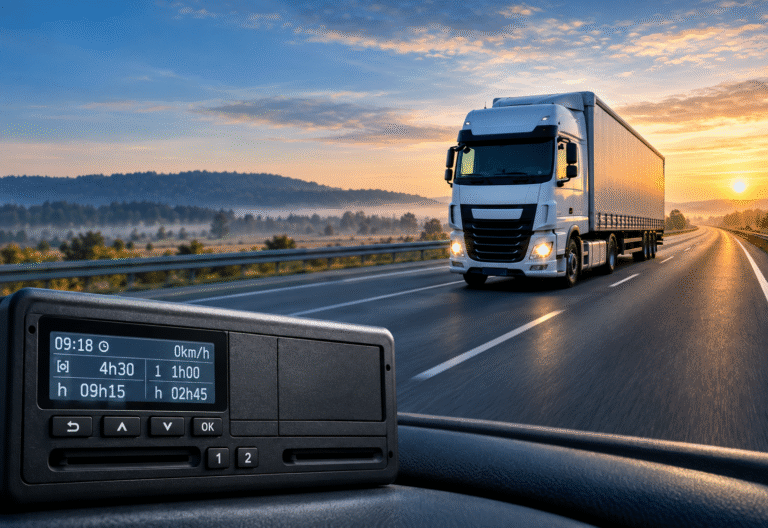
Affected vehicles between 2.5 and 3.5 tonnes must be fitted with a second-generation smart tachograph, also known as Smart Tachograph 2.
The tachograph records, among other things:
- driving, rest and availability periods;
- time spent on other work;
- vehicle speed and distance travelled;
- the position of the vehicle;
- border crossings;
- the location of loading and unloading operations.
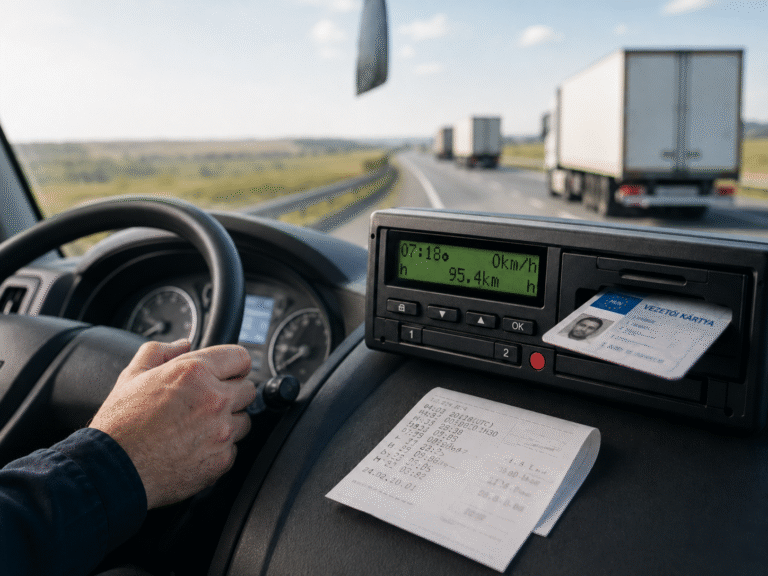
Smart Tachograph 2 automatically records border crossings. Loading and unloading operations, however, must be selected by the driver in the tachograph menu so that the location of the activity can also be recorded correctly.
European Commission guidance on the tachograph rules under the Mobility Package
What does this mean for drivers?
Installing a tachograph is not only a technical requirement. The affected drivers will also become subject to EU driving-time, break and rest-period rules.
The main limits include:
- the daily driving time is normally limited to 9 hours;
- it may be extended to 10 hours no more than twice during a week;
- the weekly driving time may not exceed 56 hours;
- the total driving time during any two consecutive weeks may not exceed 90 hours;
- after 4 hours and 30 minutes of driving, the driver must take a break of at least 45 minutes, which may be split into periods of 15 and 30 minutes under the applicable conditions.
Daily and weekly rest periods must also be properly planned and recorded.
The driver must hold a valid driver card and insert it into the tachograph before starting to drive. During roadside inspections, enforcement authorities may examine the data stored on both the driver card and the tachograph.
The driver is responsible for:
- selecting the correct tachograph mode at all times;
- recording other work, such as loading, unloading or vehicle inspections;
- correctly entering the country where the working day begins and ends;
- completing missing periods using manual entries;
- using only their own driver card;
- following the printing and manual-recording rules if the tachograph or driver card malfunctions.
Are there any exemptions?
Not every van exceeding 2.5 tonnes automatically falls within the scope of the rules.
An exemption may apply in certain cases, for example where a vehicle between 2.5 and 3.5 tonnes is used:
- to carry goods on the company’s own account rather than for hire or reward;
- where driving is not the driver’s main activity;
- for entirely non-commercial carriage of goods;
- to transport materials, equipment or machinery required for the driver’s own work, provided that all other legal conditions are also met.
Exemptions must always be assessed according to the specific transport operation, the way the vehicle is used and the route involved. The fact that a vehicle is owned by a company does not in itself create an automatic exemption.
How does this affect transport companies?
The change will have a significant impact on smaller transport companies operating vans.
Additional costs
Companies will need to account for:
- the installation of a Smart Tachograph 2 device;
- tachograph calibration, activation and periodic inspections;
- driver cards and company cards;
- systems for downloading and archiving tachograph data;
- appropriate training for drivers.
Changes to route and working-time planning
Transport operations can no longer be planned solely according to distance and delivery deadlines. Companies must also take driving limits, mandatory breaks, daily and weekly rest periods and the availability of suitable parking locations into account.
This may have a particularly significant impact on express deliveries and transport assignments with tight deadlines.
Greater enforcement and traceability
The smart tachograph automatically records border crossings and assists the authorities in checking compliance with driving-time, cabotage and driver-posting rules.
Enforcement authorities can also detect certain tachograph information remotely, allowing them to target vehicles that may be suspected of non-compliance.
The transport company is responsible for ensuring that:
- the driver’s work is organised in compliance with the rules;
- drivers receive appropriate training and instructions;
- tachograph data is regularly downloaded and checked;
- the required records are retained for the legally prescribed period;
- drivers are not given delivery deadlines that can only be met by breaching driving-time or rest-period rules.
Summary
From 1 July 2026, Smart Tachograph 2 will be mandatory in many vehicles and vehicle combinations exceeding 2.5 tonnes when they are used for international goods transport or cabotage operations.
This means that many van drivers will become subject to the same basic driving-time and rest-period requirements that already apply to drivers of heavier goods vehicles.
Drivers must learn how to use the tachograph and driver card correctly, while transport companies must adapt their route planning, data management and working-time organisation.
The purpose of the rules is to reduce driver fatigue, improve road safety and create fairer competitive conditions for transport companies across the European Union.
Important: any applicable exemption, the maximum permissible mass of the vehicle or vehicle combination and the rules applying to the specific transport operation should always be checked individually.